The Korea Research Institute of Chemical Technology recently reported to have developed a 100% biodegradable N95 mask filter that decomposes in dirt. Using a biodegradable mask filter than can be replaced after every few uses( the filter itself is also reusable) will definitely reduce plastic usage as plastic masks themselves do not need much replacement. Not only this discovery, but also, a university student in Korea started designing chairs made out of used masks after the outbreak of COVID-19, when he noticed the insane amount of masks in the garbage fills.
The material of the mask itself is propylene, and also includes chitosan chemicals, which enables the mask to be resistant to moisture. A research team led by professors Sung-Yeon Hwang, Dong-Yeop Oh and Jae-Young Park used a biodegradable plastic material, Polybutylene Succinate (PBS), to develop a biodegradable mask filter that can be 100% naturally decomposed in one month under composting conditions.
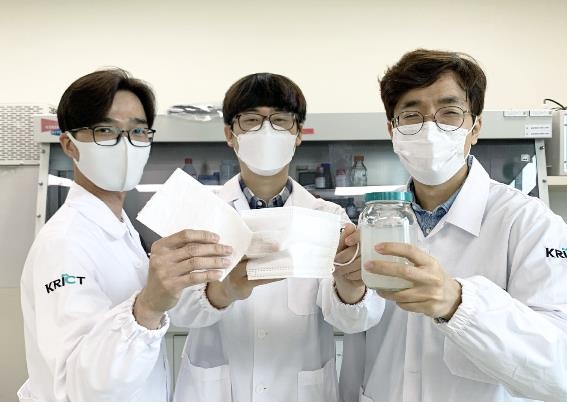
They explained that it is easier to breathe with this biodegradable filter than conventional filters, and that the mask filter is resistant to moisture and reusable for several times.
The research team first pulled out the biodegradable plastic into fine fibers with a thickness of ㎚ (nanometer·1 million mm) and fibers with a thickness of µm (micrometer·1 in 1,000 mm), and then crossed these fiber strands to make a nonwoven fabric.
Existing filters were made of only nano-sized fibers, so the space between the fibers was narrow, making it difficult to breathe, but microfibers with a slightly larger diameter were used to enhance breathability.
The resulting nonwoven fabric was coated with’chitosan nano whisker’ (a material that increased the surface area by making chitosan extracted from the shell of a crab into nano particles) to capture fine dust.
Existing electrostatic filter methods generate static electricity to stick viruses or fine dust, but the filter function deteriorates as time goes by because static electricity is vulnerable to moisture.
Since Chitosan has a positive property (+), it can attract foreign substances like fine dust or viruses that have a negative property(-) according to the charge principle. Additionally, the mask is resistant to moisture and can be reusable because it uses a permanently positively charged material, not static electricity generated temporarily.
The newly developed filter blocks 98.3% of viruses and fine dust in the air with a size of 2.5 μm, and is similar to the performance of the existing N95 mask filter.
The waste decomposition test after use also showed that it biodegrades within 28 days in composted soil conditions.
“Since we have already proposed chitosan coating ideas based on technologies we already have in Korea, it is not difficult to commercialize them.” Sung-Yeon Hwang, Director of Biochemical Materials Research, said.
The results of this study were published in the journal’Advanced Science’ on the 17th.
Additional thoughts:
I think it’s quite clever to create a biodegradable filter because as many experts state that the COVID situation is not getting any better, along with climate change exponentially exacerbating. So, even if it may take years for the entire global community to receive the COVID-19 vaccine, it may be a step closer to slowing down COVID-19 contaminations just by developing a mask filter, even a biodegradable one.
Works Cited:
“화학연, 흙에서 100% 썩는 N95 친환경 마스크 필터 개발.” 다음뉴스, 2021, news.v.daum.net/v/20210322120027595?x_trkm=t. Accessed 22 Mar. 2021.
– Joanna Kim, March 22nd, 2021, 11:40PM KST
 Biochemistry Science Blog!