Today, I streaked out the bacteria whilst making the LB Streptomycin agar plates. Hopefully I don’t accidentally screw on the lid on the glass bottle and cause an explosion when opening the glass bottle after microwaving again like yesterday..!
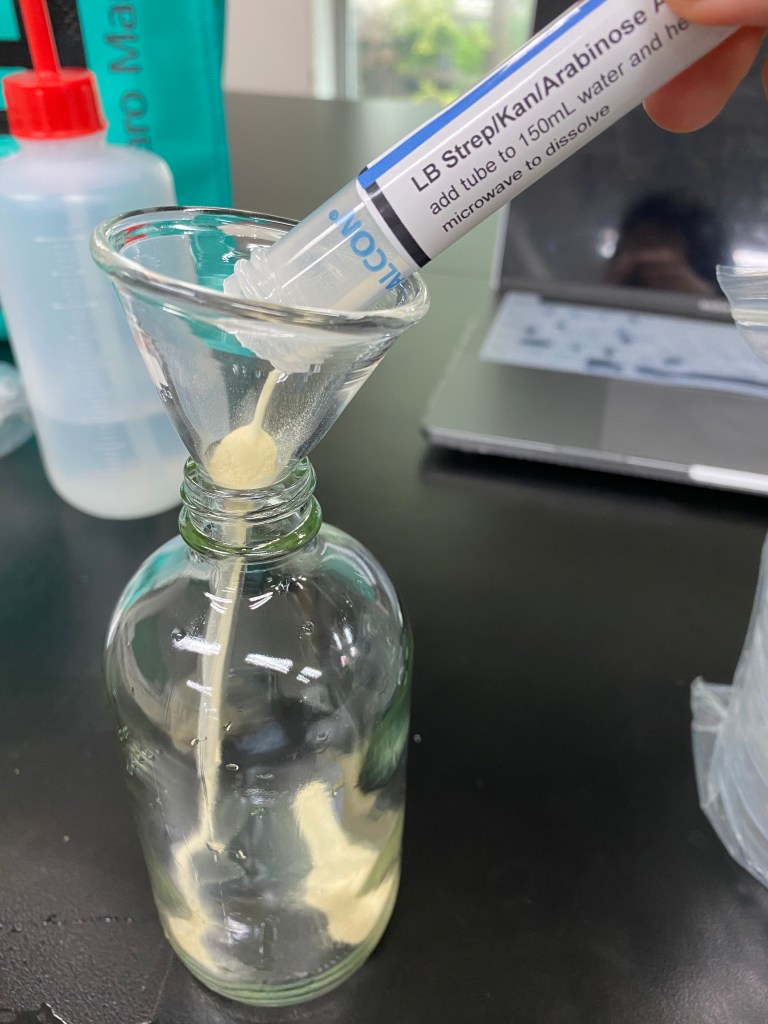
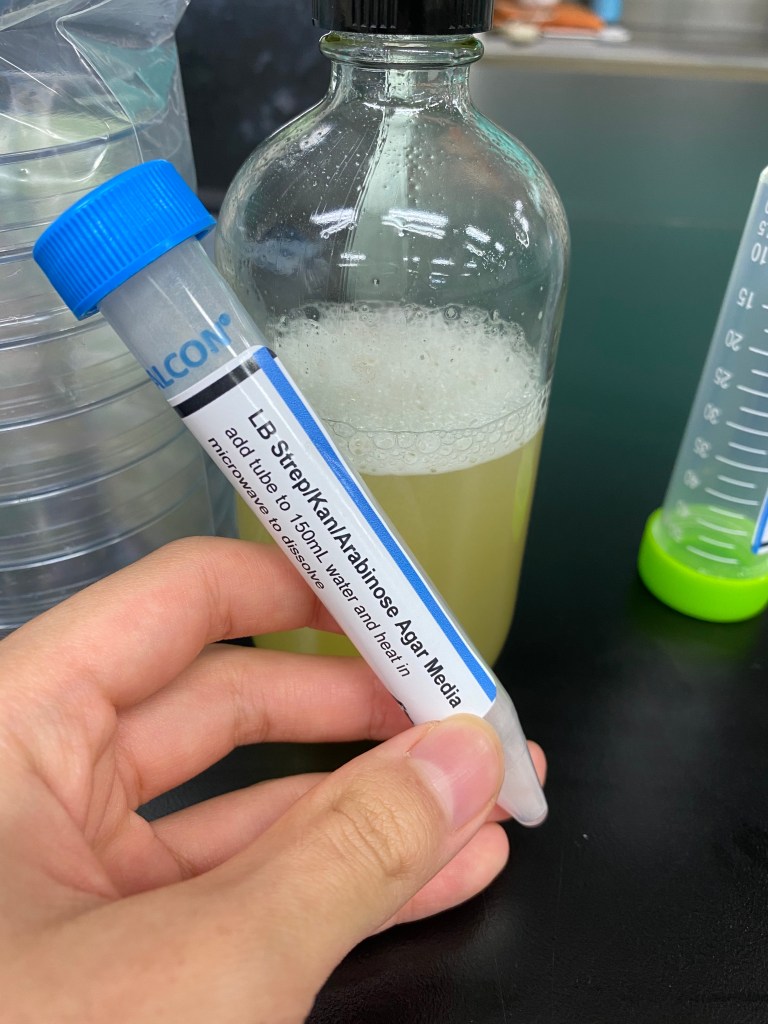
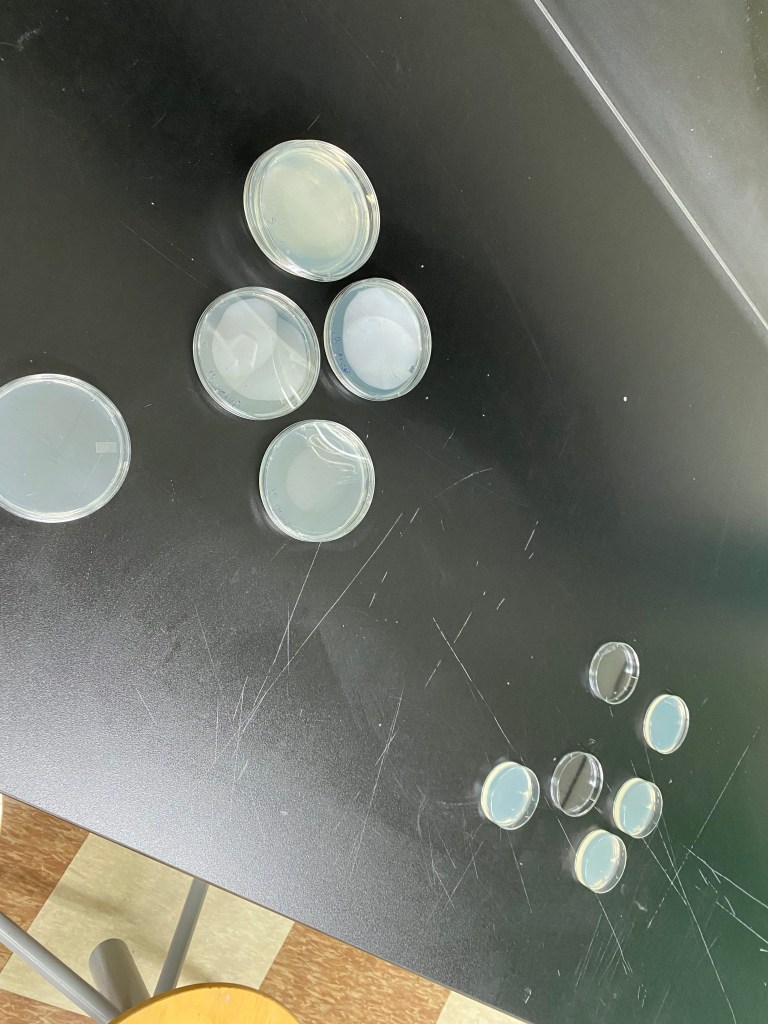
[Update] Thankfully there weren’t any mistakes in pouring in the LB Strep media/distilled water into the glass bottle, nor where there any mistakes during the microwaving process! I think it took us a bit longer than last time, but we fortunately did not overbook it this time! (Although it almost did, and I opened the microwave just in the nick of time to watch a drop of the LB Strep solution drop…) I noticed a new lab trick of removing bubbles inside a bottle – to just gently handle the bottle by caressing the bottle from side to side, kind of like a seesaw! The bubbles rapidly disappeared.
And oh my, the smell of this agar was horrendous! I mean, it did smell almost exactly like the LB Agar media, but a few hundred times stronger. Even when wearing a mask, the smell literally wafted through my mask. After we microwaved the Agar solutions, we always placed the hot glass bottle under cold running tap water to cool it down so the solution wouldn’t melt the Petri dishes. But this time, the LB Strep media inside the glass bottle bubbled for a few minutes, even as we finished microwaving (when we placed it under cold water), which probably meant it was more reactive. This can be due to the antibiotic streptomycin.
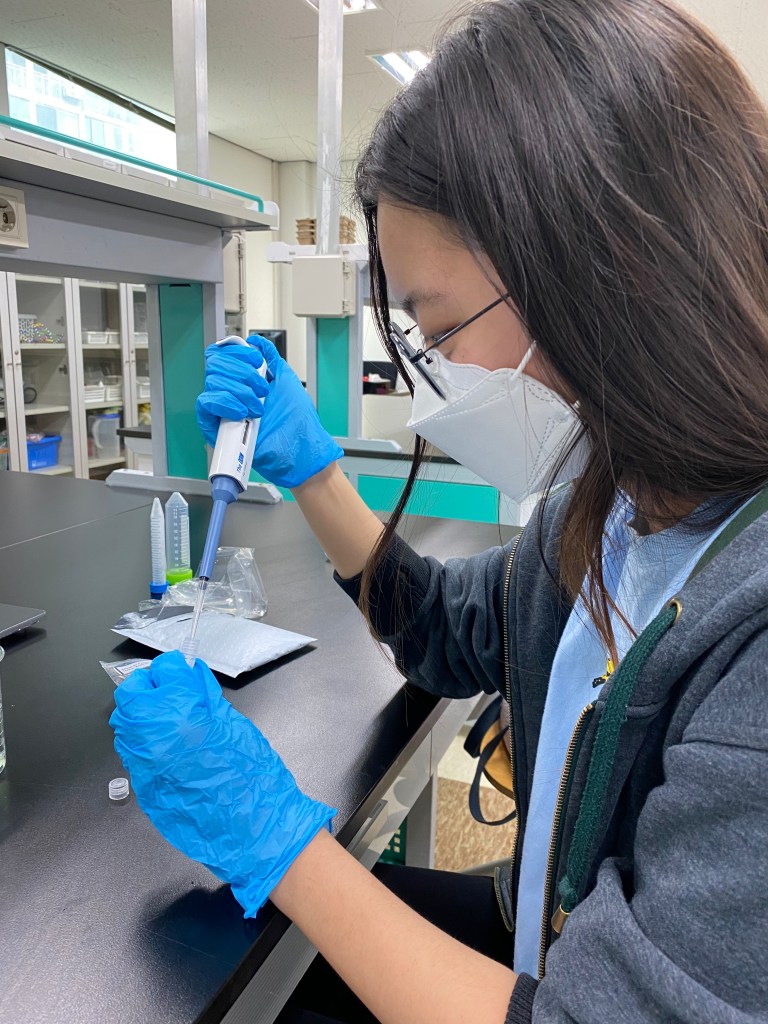
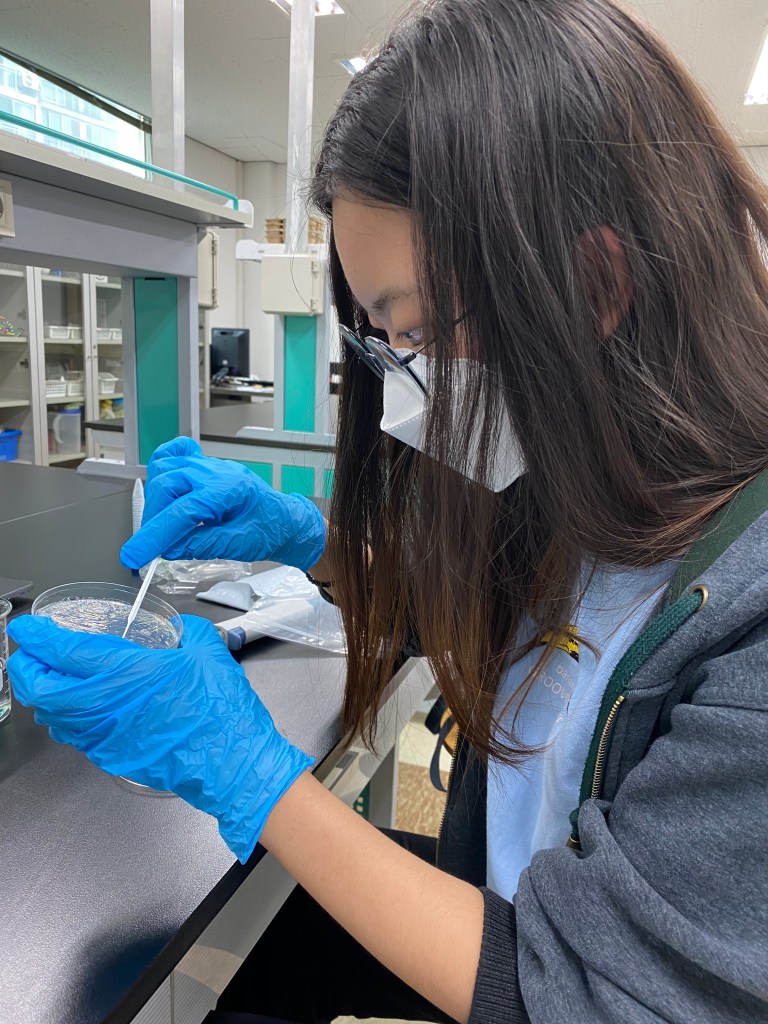
+ My biology teacher complimented that my agar-pipetting/Petri dish making skills improved from yesterday! My plates, overall, were very “clean” and barely showed any major lumps!
Argh! My remorse for the LB Agar Petri dishes is worsening. We should have followed the instruction manual directions to let the plate dry and THEN putting the lid on to avoid condensation and water dripping onto the agar media. However, as my biology teacher and I were talking about the possible ways of contamination (because heavy contamination happened in my very first CRISPR experiment during the summer that even fungi started to grow..!) so we could avoid it, and one of the ways that were mentioned was the duration of exposure of the plates, whether bare without any media in it, or full with the Agar media in it. But because I did not want fungi on my plate again, I remember immediately closing the lid on the LB Agar media.
So, when we took out the LB agar media plates to inoculate them with the bacteria, many of them were frozen from the water that had dripped onto the agar gel due to condensation. I really regret this because it can be a huge extraneous factor to our results. Some of the plates even crystallized, and it was actually kind of pretty not going to lie – kind of looked like the scene in Frozen I when Elsa’s ice castle starts to crystallize and build within itself by itself. Very complex structures and lines, I say.
Then, I learned that while pipetting, when putting on the tip, instead of just gently placing the pipette onto a new tip, I could just aggressively stab it down a few times inside the box to really secure the tip in place just in case it falls while pipetting. I also learned that I didn’t have to press all the way, just only to the first stop of the button because the more I pressed, more excess amounts of liquid than the required amounts were sucked in, which made it much more easier than my summer experiment (where I remember my hands were trembling because even pressing until the second stop was really tiring)..
We practiced a bit with the practice beaker and normal tap water, just sucking and pushing. Then, we went into real-test mode, but realized the liquids were not the ones described in the manual, and realized they were some other materials in the lab. But thanks to this experience, I got to see what a rabbit’s muscle looks like! It kind of looked like an extremely thin carrot stick..
But anyways, we eventually found our solutions in the fridge, and added 100µL of sterile water (finally not frozen for this experiment! Woohoo!), my pipetting was successful. But since there was so little bacterial mix, we decided to inoculate it to ONE plate only and then streak the bacteria onto other plates later on. The bacteria was definitely harder to see because it was a liquid and there was already melted condensation in the plate, so I’m not sure what might happen tomorrow or soon.
As my biology teacher wanted to sterilize the inoculation loops one more time, he placed one right above the fire and it immediately melted, so we had to quickly swish an inoculation loop high above (far away) form the fire to not melt it, but also sterilize it at the same time. But as the plates were all frozen, the agar gel was a bit stiff, and so my biology teacher suggested us to slightly break the agar apart using the loop, which kind of failed as it teared away some pieces. But! for now, we will have to wait for the bacteria to grow, and we can streak it onto other plates.
I’ll check tomorrow’s status of the Petri dish, and if the bacteria has fully cultivated itself, I can apply the CRISPR Cas9 process, and if not, I think I’ll have to wait a bit more! Science is patience!
– Joanna Kim, April 29th, 2021, 1:01AM KST
 Biochemistry Science Blog!