For my ongoing project this semester, I decided to create a few picture books regarding CRISPR for young Korean children in English and Korean. However, to do so, I would need to master all information regarding the process so I can deliver the information in the most accurate and easiest way possible so the kids can understand.
Thus, I begin with my studies in protein formation as CRISPR utilizes the protein Cas9 and other important RNA/DNA segments that are essential in the formation of protein.
Definition of a Protein
Proteins are complex biomolecules formed by amino acids bonded with peptide bonds. Though proteins are prevalently essential amongst all organisms, they can contrast significantly based on their amino acid composition, sequence, location, function and spatial configuration. The amino acids, which compose a protein, are composed from the nucleotide sequence of its DNA. Based on the sequencing of the amino acids, the folding of the protein can widely differ, changing the function of the protein as well.
Functions of the protein can differ based on its type.
A Few Examples of Common Protein Types
- Enzymes
- Definition: A catalyst, which speed up chemical reactions by lowering activation energy (the energy required to start a reaction). Catalysts convert substrate molecules into products, which all differ based on the catalyst’s function/type.
- Common example: Salivary amylase. Helps break down the amylose sugar in foods into smaller sugars to aid digestion and decomposition in the stomach and other digestive organs.
- Hormones
- Definition: Hormones are chemical signals secreted by endocrine cells of the pituitary gland and transported to distant organs to control particular physiological processes. Hormones can either be steroid-based or protein-based, which are called as peptide hormones for those based on proteins.
- Common example: Insulin, an essential peptide hormone, helps regulate blood glucose levels. In high blood glucose levels, insulin, which are secreted by the pancreas, bind to cells in the liver and other organs to enable them to absorb the glucose. This peptide hormone is especially essential in maintaining body homeostasis.
- Antibodies
- Definition: Antibodies, a.k.a immunoglobulin, aids in recognition of foreign substances, especially pathogens. In its process of recognition, the antibodies look for antigens; however, in the actual process when the antigens bind to the antibodies, the shapes of the surfaces of the antibodies are very antigen-specific. Hence, according to the lock-and-key hypothesis, such substances are able to bind to each other accurately.
- Common example: Immunoglobulin G, the most common antibody in our body, can mark a pathogen for other immune cells to recognize it or signal other cells to secrete toxins to kill the pathogen.
Amino Acids Essentials
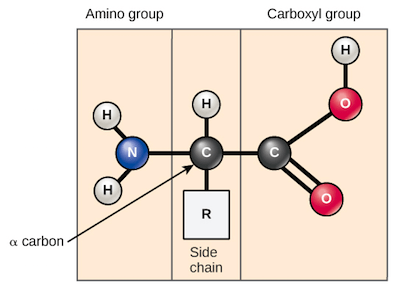
- Multiple polypeptides (each one is a chain of amino acids) compose a protein. The most fundamental structure of amino acids consist of a central alpha carbon atom bonded to an amino group, a carboxyl group and a hydrogen atom.
- These amino acids of a polypeptide are covalently bonded by peptide bonds. During protein synthesis, the carboxyl group of the amino acid reacts with the amino group of an incoming amino acid, resulting in the release of a water molecule.
- Due to the structure of the amino acids, a polypeptide chain has directionality (= two ends are chemically different from each other). While one end has a free amino group called the “amino terminus (N-terminus)”, the other end has a free carboxyl group called the “carboxyl terminus (c-terminus)”.
The next part of this lesson will handle protein folding.
– Joanna Kim, March 22nd, 2022, 11:10 PM KST –
________
Works Cited:
“Protein – Definition and Examples – Biology Online Dictionary.” Biology Articles, Tutorials & Dictionary Online, 22 Dec. 2019, http://www.biologyonline.com/dictionary/protein. Accessed 18 Mar. 2022.
“Khan Academy.” Khanacademy.org, 2022, http://www.khanacademy.org/science/biology/macromolecules/proteins-and-amino-acids/a/introduction-to-proteins-and-amino-acids. Accessed 22 Mar. 2022.
“Protein.” The Nutrition Source, 18 Sept. 2012, http://www.hsph.harvard.edu/nutritionsource/what-should-you-eat/protein/. Accessed 22 Mar. 2022.
 Biochemistry Science Blog!