My class and I recently conducted the Egg Drop Challenge at school. Though my efforts were initially dedicated towards receiving a high grade for my project, I found myself really engaging into the project and spending hours and hours working on it.
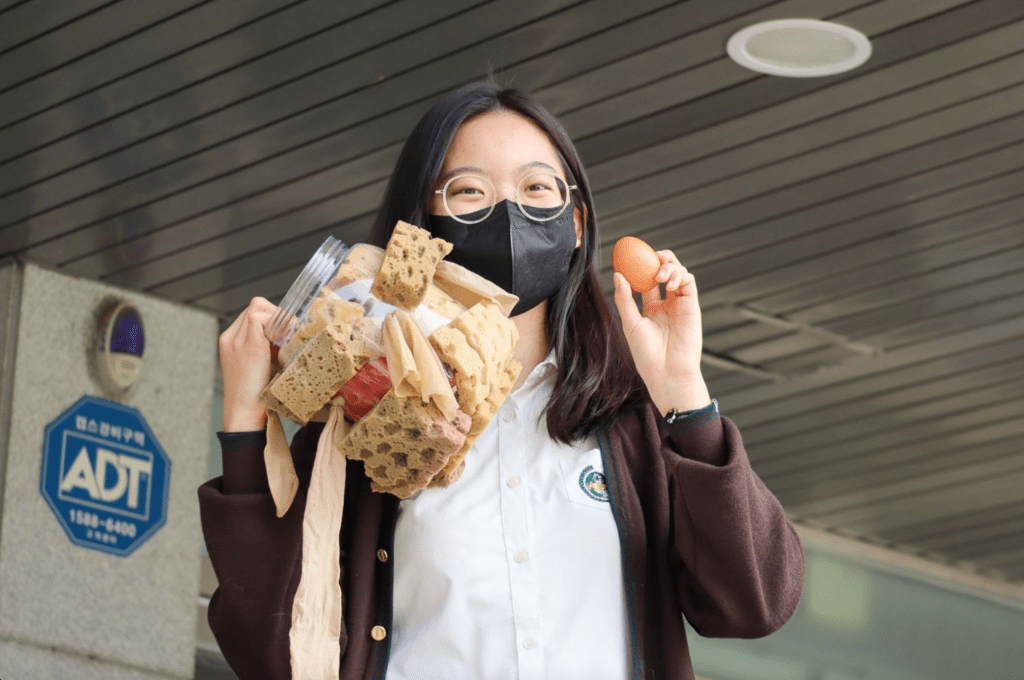
The purpose of this lab was to engage the concept of impulse in constructing an egg lander that could safely land the egg on the ground without cracking it. We were asked to construct two different landers.
Our first lander was mainly focused on building a force-absorbing contraption, mainly through the help of dense sponges and elastic potential energy.

Our initial plan was to surround the egg in a bunch of sponges in a container. By gluing dense sponges to the inside walls of the container and inside the lid as well, it would safely cushion the egg from any flat, hard surfaces. However, even if such a contraption were to be built, the force of collision with the ground would be so strong for solely the inside sponges to support the egg. Thus, we stuck cushions around the outside of the large container.
But regardless of the number of sponges stuck in the container, there still was a slight possibility that the force of collision would still be too strong for the egg to be safely cushioned; thus, if dropped from an elevated distance from the ground, the egg would be moving around in the container too quickly that the supporting cushioning would not be effective.
Consequently, came the “net” plan. As we were requested to build our landers only using reusable materials, we thought reusing worn-out high compression stockings would be effective in reducing some of the collisional force on the egg. By building an X-shaped net with the compression stockings, we would suspend the egg in mid-air while tightly securing it from flying randomly out of the container or strongly colliding into the walls of the container.
By placing the egg inside the compression stocking and then placing a stretched stocking above and beneath the secured egg in a perpendicular direction to the stocking that contained the egg inside created an x-shaped net. The stretchiness of the stockings would be tight enough to convert the force from collision into elastic potential energy. We also placed some bubble wrap above and beneath the egg as well so that it would ensure the egg was fully secured and surrounded by cushiony material.
When this lander dropped, it collided with the ground very aggressively, so my partner and I were very concerned about the egg cracking. Thankfully, it didn’t crack!
I think the success of lander 1 was especially reliant on the usage of sponges. This material was crucial in the success of this contraption as it helped absorb the force of impact from collision to the ground by increasing the amount of force applied on the sponges themselves, thus decreasing the magnitude of the force applied on the egg. Additionally, the stocking was of equal importance as its tense material allowed the egg to stay suspended midair, so there was some elastic potential energy stored in the stockings when they were tensely pulled and tied to the container.
Although all materials were very much needed in constructing contraptions that successively protected the egg, the bubble wrap for lander 1 was probably the most unnecessary, considering the fact that the egg was not only already fixed in a secure and tense net from one stocking in mid air, but also was protected by a top and bottom net of stockings tied perpendicular to the first net, creating an x- shape. Additionally, the fact that the container itself was also protected by a large number of big, dense sponges to absorb the force ensured the egg was secured. Thus, the addition of bubble wrap could have been unnecessary as the egg was secured enough already and it could have increased the mass of the contraption. This could have contributed to the container falling at a faster rate than it would have without the bubble wrap.


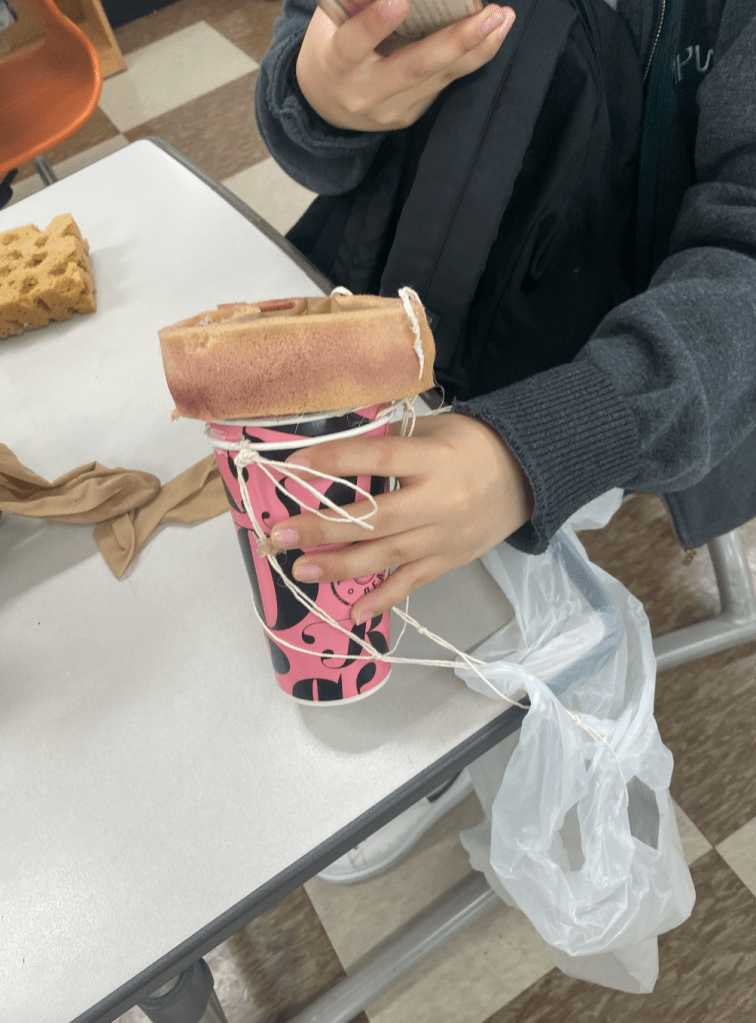
Our second lander was more focused on the effect of air resistance on slowing the momentum of the landing, through the usage of a parachute and a heavy mass on the bottom of the lander.

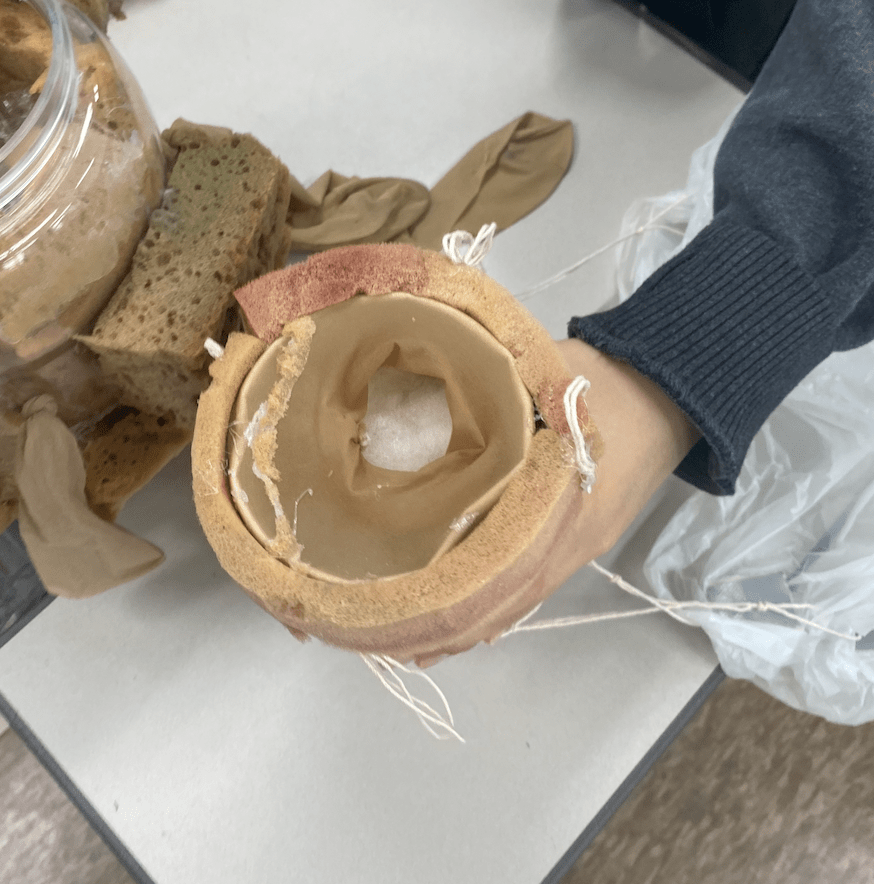
By stacking multiple cups together, we thought placing a heavy object in the bottom cup would ensure the lander would fall straight down, rather than tumbling to the side. Also, we also wanted to decrease the force on the egg by stacking the cups so that the egg would be secured at the top cup with compression stockings once again.
However, we also affixed sponges to the sides of the top cup in case the cup fell sideways. By placing the egg in a tense net made by the stocking, the egg would be secured. Also, we added cotton in the top cup, right underneath the egg, so that even if the egg fell down a bit to the bottom of the first cup due to the force from collision with the ground during the landing, it would still be supported by a sort of cushion.
We didn’t have a trash bag at the beginning, but thankfully, we were able to acquire one through politely asking the janitor lady if she had one. I’m still so glad that she was very supportive and excited about our project. She wished us the best of luck that day, and it really made my day.
We tied string to the parachute and tied knots at the bottom end of the string, which we hot-glued to the bottom cup. By utilizing the plastic bag as a parachute, the parachute would open during the fall due to the wind pushing the bag open as the lander would fall vertically straight down because of the heavy mass at the bottom of the lander.
I think the success of lander 2 was more dependent on the plastic bag, which acted as a parachute. During the fall, the contraption felt more air resistance due to the parachute than it would have if there were no parachute at all. When falling, the parachute opened, increasing air resistance, which thus, decreased the relative force of the fall and collision on the ground due to its increase in the time of fall.
For lander 2, the sponges were least effective in contributing to a successful fall. Considering our plan to place a heavy object on the bottom of the contraption with a parachute on top, the contraption already was most likely to fall vertically down at a relatively slow rate due to the parachute and the heavy mass. Additionally, during the actual fall, the mechanism did fall vertically down, proving the high probability for the contraption to fall down vertically at a slow rate. Therefore, the addition of the sponges could have been unnecessary as it only added to the mass of the contraption and also was unnecessary in terms of function as sticking it to the sides of the lander only provided support to the contraption in case the egg fell sideways.
Some key factors that my partner and I took into consideration during construction of the lander were the amount of time of fall and the magnitude of force applied on the eggs during the landing. Thus, for both contraptions, our main objective was to decrease the magnitude of force applied by increasing the time of fall in different methods (via increasing air resistance or adding an external factor that would absorb the force instead).
Honestly, impulse was a difficult concept to grasp when learned through lectures. However, that confusion cleared up a bit after actually experimenting impulse through building contraptions and seeing how they take place in momentum and impulse during the course of a fall.
I do wonder if my other initial plan of placing the egg inside oobleck (without any special container or bag) and dropping the egg + oobleck mass would be successful. This was an idea that I brought up during the discussion of ideas my partner and I had at the start of the project. Since oobleck is a non-newtonian fluid, there were wonders I had whether solely placing the egg in oobleck would allow the egg to survive or not, though there are doubts about it’s feasibility, considering the amount of force on the egg depending on the height of the fall.
I still remember staying until 7pm afterschool to finish lander 1, a day which the soccer game was held at our school. I could literally hear screams of excitement from outside the windows, when our varsity team had scored a goal. I also burned myself that day — what a pleasant surprise gift from my glue gun. But, I believe all those sacrifices in my free time to work on a project I was so passionate about to learn and clear confusion really helped deepen my understanding in impulse and motion.
– Joanna Kim, May 7th, 2022, 11:42PM KST –
 Biochemistry Science Blog!