
*Mild flashbacks to my AP Chemistry video project on the exact same experiment..*
Prepare yourselves for an ACIDIC adventure! Today’s class was about exploring acidities of different household liquids and beverages we commonly enjoy or use through a natural indicator found in red cabbage.
Though it was difficult to explain the concept of pH and acid/base indication for the younger students, I think my prior experience with researching about this experiment and the topic in quite a deep extent saved me from helplessness.
pH is a unit of acidity, ranging from 0 to 14. A pH value of 7 is considered neutral, and any pH value lower than 7 is considered acidic, while any above pH 8 is considered basic/alkaline. The students struggled to understand the definition of alkaline/basic solutions, so when I provided the example of a basic solution as soap, they immediately understood.
There are a variety of tools that can help assess the acidity level, or pH, of a certain solution. The most common tools are:
- pH meters: as the more sophisticated tool amongst the other choices to determine acidity, these pH meters report an absolute, specific value in the pH range of 0~14. The acidity/alkalinity can be determined by comparing the value reported by the pH meter with the pH concept. (<7 = acidic, =7 = neutral, >7 = basic)
- pH indicator: there are many types of pH indicators that are available to use depending on the type of solution/chemical used in the experiment. One of the widely used indicators is phenolphthalein, which changes color from colorless to a bright pink shade depending on the solution’s acidity. Based on color changes in the solution with the indicator inside and comparing the color in the solution with a pH color chart specifically made for the indicator used, the acidity/alkalinity can be estimated. (This is less precise than the pH meter in determining a very accurate pH value.)
While these pH-determining tools are often associated with the idea that they can only be found in professional laboratory settings, a natural pH indicator is actually found in an organic ingredient — red cabbage. It contains the chemical anthocyanin that attributes to the color changing trait based on acidity. The image below is a pH color chart of this anthocyanin chemical:

Picture credits to Andy Brunning
I asked the kids to bring their own favorite drinks from home, and to my surprise, they all brought very different drinks (I expected the majority of them would bring coke or some carbonated beverage)
Thanks to a discovery I made from my own AP Chemistry video project, I brought bleach to surprise the kids when doing the experiment (spoiler alert: it turns yellow!)
The experiment itself is very easy to prepare — you just need to boil some water with red cabbage inside and brew the cabbage. Of course, throw out the cabbage or eat it.
Unfortunately, I didn’t take photos during the experiment itself while trying to stop the kids from trying to push each other to go first, but here are some photos taken from another student teacher:


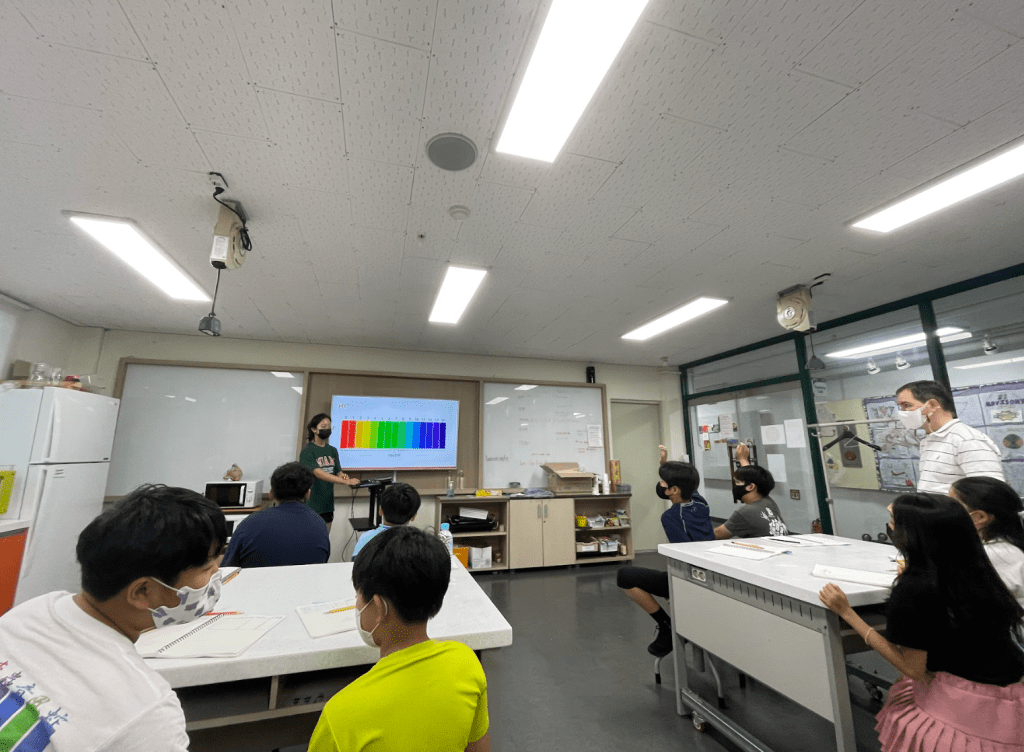

The kids eventually took turns, but once they were done testing all the liquids they brought, they started running around the kitchen to find some kind of random liquid, and mixed it into the red cabbage solution. Interestingly, when they mixed two cups, both of which had already undergone color change in the indicator due to an addition of the students’ juices, the color change still occurred based on the overall pH of the solution.
– Joanna Kim, August 2nd, 2022, 9:38PM KST –
 Biochemistry Science Blog!